
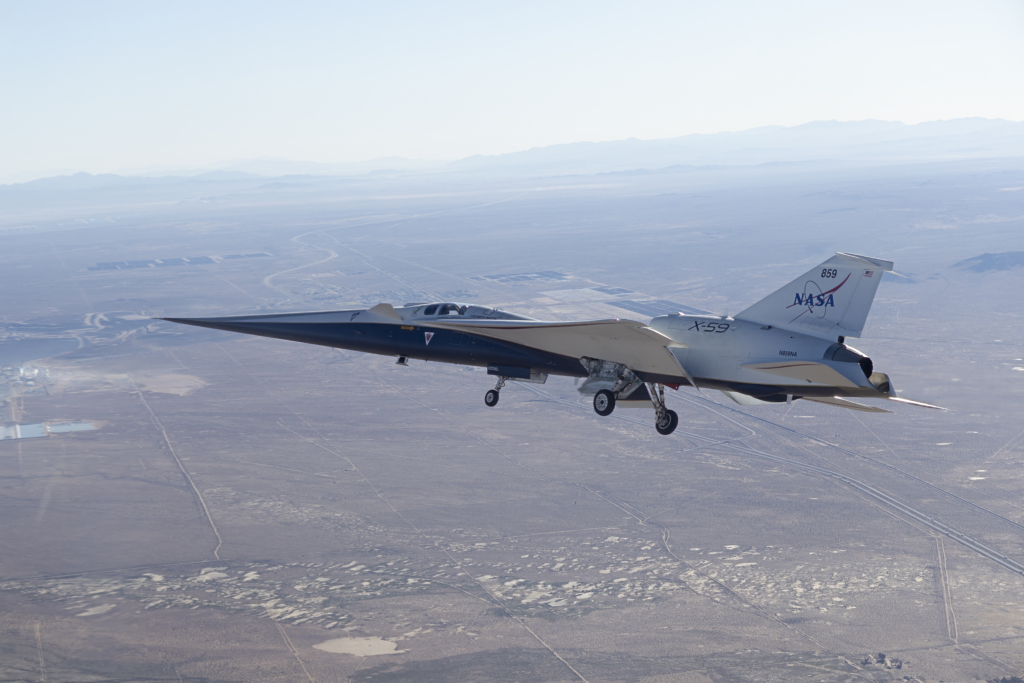
NASA has published a detailed explanation of how sonic booms are created as its X-59 experimental aircraft moves closer to the phase of its mission that could determine whether quieter supersonic flight is accepted over land, while the FAA works on a noise-focused regulatory framework to replace the 1973 overland supersonic ban.
NASA has published a detailed explanation of how sonic booms are created as its X-59 experimental aircraft moves closer to the part of its mission that could determine whether quieter supersonic flight can eventually be accepted over land.
The timing is significant: the X-59 has already reached the speed and altitude NASA says it needs for future community flights, while the FAA is working on a regulatory framework that would replace the longstanding prohibition on civil supersonic flight over land with a performance-based, noise-focused approach.
Reaching mission conditions
The X-59 crossed an important threshold on June 5, flying faster than Mach 1 for the first time - approximately Mach 1.1, or 713 mph, at 43,400 ft during an 81-minute flight from Edwards Air Force Base in California. A week later, on June 12, it reached Mach 1.4, about 924 mph, at 55,000 ft - the "mission conditions" at which the aircraft will eventually fly over communities to collect data on how people respond to its quieter sonic signature.
Why sonic booms occur
A sonic boom is not a single sound created at the instant an aircraft passes Mach 1. A supersonic aircraft generates a system of pressure disturbances and shock waves as it moves through the atmosphere faster than sound. As those shock waves propagate toward the ground they can merge into the stronger pressure changes heard as the familiar sonic boom, spreading outward to create a broad ground "carpet." At 55,000 ft, a sonic boom can take almost a minute to reach the ground.
Designing a quieter "thump"
Rather than trying to stop shock waves altogether, NASA and Lockheed Martin designed the X-59 so the waves generated by different parts of the aircraft are managed and shaped to reduce the intensity of what reaches the ground - a softer "sonic thump" instead of an explosive boom. Its long, slender nose and carefully arranged airframe are central to that approach.
After remaining flight-envelope work is completed, the Quesst mission moves into acoustic validation, then flies the X-59 over selected U.S. communities to gather public-response data. NASA intends to share those results with U.S. and international regulators to help establish acceptable noise thresholds for supersonic flight over land - a question that has become more immediate as the FAA develops its new regulatory framework to replace the 1973 ban on civil supersonic overland flight.